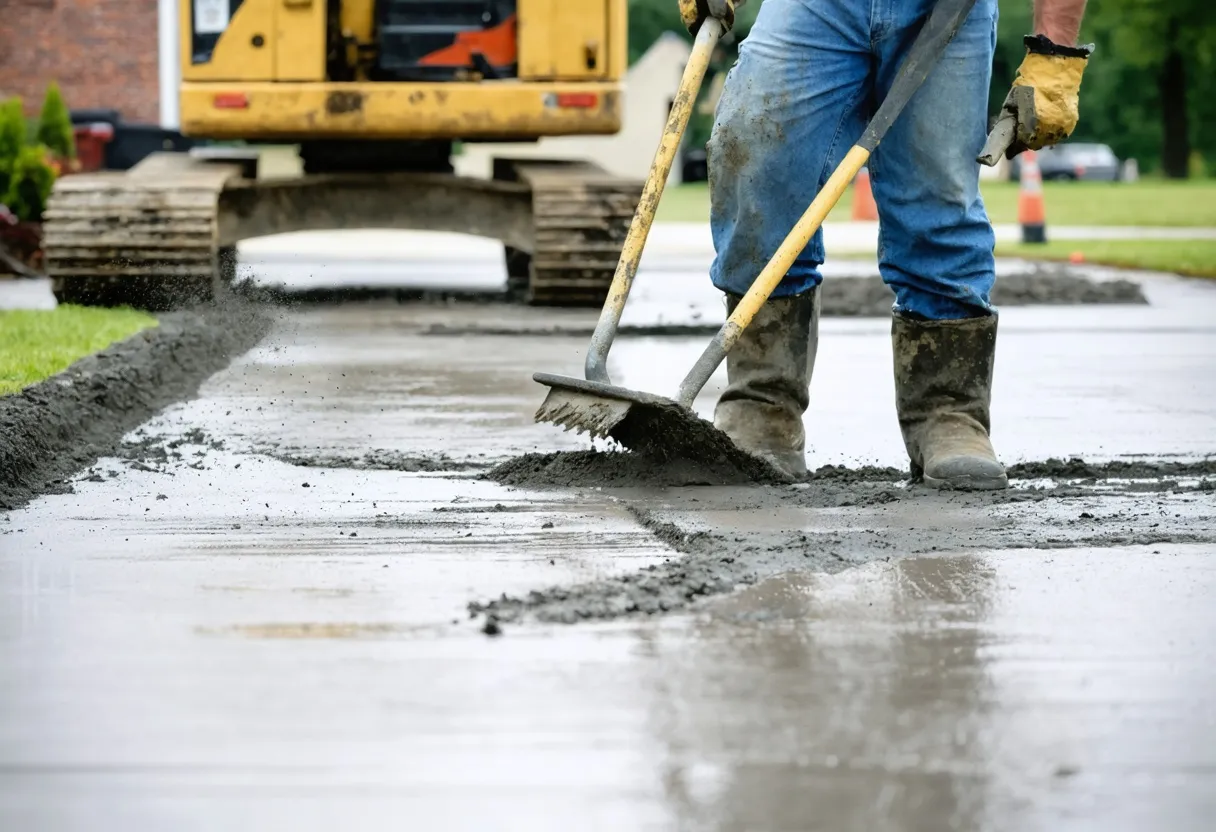
If you're pricing out a new driveway, patio, or concrete repair in Tuscaloosa, you've probably noticed that every contractor gives you a different number and almost none of them explain why. That's the gap this page fills. Instead of a generic national price chart that has nothing to do with West Alabama, we're going to walk through exactly what drives concrete pricing here -- the clay soil, the rainfall, the site prep, the finish you choose -- so you can evaluate a quote instead of just hoping it's fair. This page covers concrete driveway installation in Tuscaloosa, patio costs, financing, warranty coverage, and the full range of concrete and masonry work homeowners and business owners in this area typically need.
Tuscaloosa sits on soil that most out-of-town estimating templates don't account for. Much of the region has heavy clay subgrade that expands and contracts with moisture, and the area sees roughly 55 inches of rain a year -- well above the national average. That combination is the single biggest reason two driveways that look identical on paper can perform very differently five years later. A contractor who understands local ground conditions will grade, compact, and reinforce differently than one who doesn't, and that difference shows up in both the price and the lifespan of the slab.
What Actually Drives Concrete Driveway Cost in Tuscaloosa
There's no single "price per square foot" that applies to every property, and any contractor who quotes you a number over the phone without seeing your site is guessing. Instead, focus on the factors that actually move the number up or down. These are the same pricing factors that apply across Alabama, but a few of them matter more here specifically because of our soil and climate.
Site Preparation and Soil Conditions
This is usually the biggest variable in any Tuscaloosa concrete quote. Clay-heavy soil holds water, swells when it's saturated, and shrinks when it dries out. If a crew pours directly on unstable or poorly compacted clay, you're setting up the slab for cracking and heaving down the road. Proper prep means excavating to the right depth, bringing in a compactible base material (usually crushed stone), and compacting it in lifts before any concrete goes down. On a lot with drainage problems or a lot of existing clay near the surface, this step alone can account for a meaningful share of the total project cost -- but skipping it is how driveways fail in year three instead of lasting twenty years.
Drainage and Grading
With around 55 inches of rain annually, water management is not optional here. A driveway or patio that doesn't shed water properly will pond, erode the base beneath the slab, and accelerate cracking. Proper grading, and in some cases a drain line or a change in slope direction, adds cost up front but is far cheaper than repairing a slab that's been undermined by standing water for a few rainy seasons.
Slab Thickness and Reinforcement
Standard residential driveways are typically poured thicker than a sidewalk and reinforced with steel rebar or wire mesh to resist cracking from vehicle loads and soil movement. If you're planning to park a boat, RV, or heavy truck on the slab, thicker concrete and heavier reinforcement are usually recommended, which affects both material and labor cost.
Access and Demolition
If there's an old driveway, patio, or slab that needs to be broken out and hauled away first, that's an added cost most homeowners don't budget for. Tight side-yard access, mature trees near the pour site, or utility lines running through the work area can also slow a crew down and add to labor time.
Finish and Design Choices
A basic broom finish is the most economical option. Stamped patterns, exposed aggregate, decorative borders, integral color, and control-joint patterns all add cost because they require more skilled labor and, in some cases, specialty materials or sealers. None of these are necessary for a durable driveway, but they matter if curb appeal and resale value are priorities.
Project Size and Shape
Larger, simpler rectangular pours are generally more cost-efficient per square foot than small, oddly shaped, or curved areas, since forming and finishing complex shapes takes more time relative to the concrete volume placed.
Seasonal Timing
Concrete can be poured in Tuscaloosa most of the year, but summer heat and winter cold both require adjustments -- different curing techniques, additives, or scheduling around rain windows -- which can affect both price and timeline. We cover this in more detail in the FAQ below.
Concrete Patio Cost Tuscaloosa: What's Different From a Driveway
Patios share most of the same cost drivers as driveways -- site prep, drainage, thickness, and finish -- but a few things shift. Patios don't need to support vehicle weight, so they're typically poured thinner than a driveway, which can reduce material cost. On the other hand, patios are more likely to include decorative finishes like stamped concrete, exposed aggregate, or integral color, since they're an extension of outdoor living space rather than a purely functional surface. Patios also tend to have more custom shapes -- curves, multiple levels, built-in seating walls -- which adds labor time compared to a straight rectangular driveway.
If you're comparing a new patio against a wood deck, it's worth thinking beyond the upfront number. We cover that comparison in detail further down this page.
How the Process Works: From Consultation to Finished Slab
A concrete project isn't a single transaction -- it's a sequence of steps, and understanding them helps you know what to expect and what a fair quote actually includes.
- Initial consultation and site visit. A contractor should walk the property, look at existing drainage patterns, check soil conditions, and discuss what you actually need the space to do (daily vehicle parking, occasional guest overflow, outdoor entertaining, etc.). Quotes given without a site visit are rarely accurate.
- Measuring and design. The contractor measures the area, discusses shape, thickness, finish, and any decorative elements, and identifies where control joints will go to manage cracking.
- Written estimate. You should receive a detailed, written quote that breaks out demolition (if needed), site prep, base material, concrete volume, finish, and any add-ons like sealing or a warranty. If a quote is a single lump number with no breakdown, ask for detail before signing anything.
- Scheduling around weather. Concrete needs a dry window to pour and finish properly, and given Tuscaloosa's rainfall, a good contractor builds in some scheduling flexibility rather than pouring into a forecasted storm.
- Demolition and excavation (if applicable). Old concrete is broken out and hauled off, and the area is excavated to the correct depth for base material.
- Base preparation and compaction. This is the step that matters most on clay soil -- a properly compacted gravel base gives the slab a stable foundation that resists the shifting of the clay underneath.
- Forming. Wood or metal forms are set to define the exact shape, thickness, and slope of the slab, including the grading needed to move water away from your house or foundation.
- Reinforcement placement. Rebar or wire mesh is laid according to the load requirements of the project.
- Pouring and finishing. Concrete is placed, screeded level, and finished with the chosen texture -- broom, stamped, exposed aggregate, or smooth trowel. Control joints are cut or tooled in at this stage to control where cracking occurs.
- Curing. The slab needs time to cure properly before it can handle foot traffic and, later, vehicle weight. We explain typical curing timelines in the FAQ section.
- Sealing (optional but recommended). A quality sealer helps protect against moisture intrusion, which matters given our rainfall totals, and can extend the life of decorative finishes.
- Final walkthrough. Any reputable contractor will walk the finished project with you, point out control joints and expected performance, and go over your warranty coverage in writing.
Service Area: Concrete Work Across Tuscaloosa and the Surrounding Towns
Concrete performs differently block by block depending on drainage, tree cover, and how a particular neighborhood's soil was originally graded when it was developed. We work throughout Tuscaloosa proper as well as the surrounding communities, including Forest Lake, Alberta City, Northport, Cottondale, and Vance. Each of these areas has its own quirks -- some have more mature tree root systems near the street that affect base prep, others sit on lower ground where drainage planning is more critical. Working across this whole footprint regularly, rather than just one zip code, is part of how a local crew builds a real sense of what holds up here versus what fails, which is different from a lead-generation site that dispatches whichever crew is available.
How Long Does Concrete Actually Last?
A properly installed concrete driveway or patio in this region can last several decades, but "properly installed" is doing a lot of work in that sentence. Longevity comes down to three things: the quality of the base preparation, the concrete mix and reinforcement used, and how well the slab manages water over its lifetime. In a market like Tuscaloosa, where clay soil movement and heavy annual rainfall are both working against a slab, cutting corners on any of those three factors shortens the lifespan significantly. Control joints, proper slope for drainage, adequate cure time before heavy use, and periodic sealing all extend how long a slab performs well before it needs major repair.
By comparison, asphalt driveways typically need resurfacing far sooner and are more vulnerable to the kind of heat we get in an Alabama summer. Concrete's longer lifespan is a big part of why it's the better long-term value even though the upfront cost is usually higher.
Residential vs. Commercial Concrete Services
Residential and commercial concrete work share the same basic principles but differ in scale and specification. Residential projects -- driveways, patios, walkways, pool decks -- are typically sized for passenger vehicles and foot traffic, with more flexibility on finish and design since curb appeal matters as much as function.
Commercial concrete work -- parking lots, loading areas, sidewalks, pads for equipment -- generally requires thicker slabs, heavier reinforcement to handle truck traffic, and compliance with accessibility and drainage codes. Commercial projects also tend to run on tighter timelines because downtime affects a business's operations, so scheduling and crew size need to be planned accordingly. If you're a business owner in Tuscaloosa evaluating a parking area or pad, it's worth asking specifically about load ratings and expected traffic patterns rather than assuming a residential-grade pour will hold up.
DIY vs. Professional Concrete Installation
Concrete looks simple -- mix it, pour it, smooth it -- but the margin for error is small and the mistakes are permanent once the slab cures. A few things make DIY concrete work riskier than it looks:
- Base prep is easy to underestimate. Without proper compaction equipment and an understanding of how deep to excavate on clay soil, a DIY base often isn't stable enough, and the failure won't show up until months later.
- Timing matters more than it seems. Concrete has a limited working window before it starts to set, and finishing techniques like floating, edging, and jointing have to happen at specific points in that window. Miss the timing and you get a rough, uneven, or cracked surface.
- Weather sensitivity. Pouring in the wrong temperature or right before rain can ruin a slab. Professionals track weather windows and adjust mix design and curing methods accordingly.
- Volume calculations and ordering. Ordering too little concrete mid-pour, or too much, creates real problems -- a cold joint from a delayed second batch is a permanent weak point.
- Tools and equipment. Proper compaction equipment, concrete vibrators, bull floats, and edging tools represent a real investment for a one-time project.
For a small stepping-stone path or a minor patch, a confident DIYer can get acceptable results. For a driveway that needs to support vehicle loads for decades on clay soil, or any project where a mistake means breaking out and repouring, professional installation is worth the cost difference.
Concrete Patio Maintenance vs. Wood Deck Maintenance
This comparison comes up constantly with homeowners deciding between a concrete patio and a wood deck, and the honest answer depends on what you value long-term.
A sealed concrete patio needs relatively little upkeep: occasional cleaning, resealing every few years, and monitoring control joints for wear. It doesn't rot, doesn't attract termites, and doesn't need repainting or restaining. Given how much rain this area gets, that resistance to moisture damage is a real advantage over time.
A wood deck requires more consistent maintenance -- annual or biannual staining/sealing, board replacement as they warp or rot, and vigilance against insect damage, all of which are more pressing in a humid, high-rainfall climate like ours. Wood decks do offer a different aesthetic and can be less expensive to build initially depending on size and design, and they're easier to modify or expand later. But over a 15-20 year horizon, concrete patios generally cost less in cumulative maintenance and last longer without structural repair.
Concrete Repair Solutions
Not every concrete problem means a full replacement. Common issues and their typical fixes include:
- Surface cracks can often be routed and filled with a flexible sealant to prevent water intrusion and further widening.
- Settling or sunken sections -- often caused by erosion of the base material underneath, which is common with our rainfall and clay soil combination -- can sometimes be corrected with slab-jacking or mudjacking rather than demolition.
- Spalling or surface flaking, frequently from freeze-thaw cycles or deicing salt exposure, can sometimes be resurfaced with a bonding overlay if the structural slab underneath is still sound.
- Large structural cracks or heaving usually indicate a base failure and typically do require removal and replacement of the affected section rather than a surface patch.
The right fix depends on whether the problem is cosmetic or structural, which is why an in-person evaluation matters more than a guess based on photos. If your existing driveway has damage and you're weighing repair against replacement, that assessment should come before any pricing conversation.
Matching New Concrete to Existing Slabs
A common request is extending a driveway or patio, or replacing just a damaged section, while trying to match the existing concrete. Perfect color matching is genuinely difficult -- concrete color varies with the age of the existing slab, sun exposure, sealer buildup, and even the specific batch of cement used originally. A skilled crew can get close on color and can match finish texture (broom pattern, aggregate exposure, or stamped pattern) fairly closely, and using a control joint or expansion joint at the seam between old and new sections helps the transition look intentional rather than like a mismatched patch. Setting realistic expectations up front on how close a match will be is part of an honest quote.
Retaining Walls and Masonry
Beyond flatwork, retaining walls and masonry are a natural extension of concrete work, and they're especially relevant here because of how our clay soil handles water and slope. A retaining wall does two jobs: it holds back soil on a grade, and it manages water runoff so it doesn't erode your yard or undermine a nearby driveway or foundation. Poorly built retaining walls -- ones without proper drainage behind them -- are a common failure point in this region, because trapped water builds hydrostatic pressure against the wall until it bows or fails. A properly built wall includes drainage gravel and, often, a drain pipe behind the wall face to relieve that pressure. If your property has a slope that's eroding or a low spot that collects water near your house, a retaining wall is often a more permanent fix than repeated landscaping patches.
Request a Free Quote
No obligation, no pressure, just a clear price for your project.
Get Your Written Quote
See the price before you decide anything.