At your service in Tuscaloosa
Concrete Foundation Contractor Tuscaloosa Al
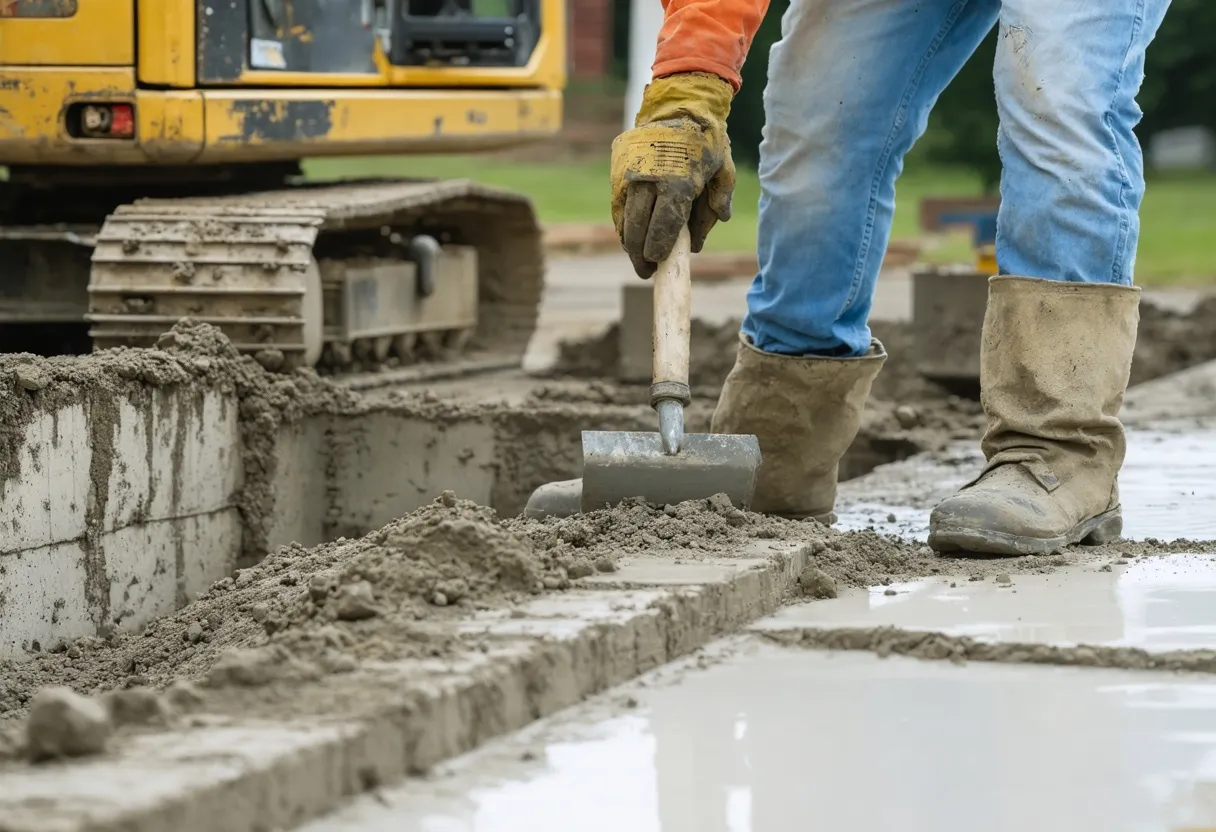
If you've watched a driveway crack into a jigsaw puzzle within a few years of being poured, or noticed a slab foundation that seems to lift and settle with the seasons, you're not imagining things and you're not alone. Tuscaloosa sits on some of the most difficult residential soil in Alabama for concrete work: dense, expansive clay that swells when it's saturated and shrinks hard when it dries out. Pair that with roughly 55 inches of rainfall a year and you get a freeze-thaw-free but wet-dry cycle that punishes concrete poured without the right prep, the right mix, and the right drainage plan. A concrete foundation contractor who works this market every week understands that cycle in their bones — it shows up in how they grade a site, how they reinforce a slab, and how they price a job honestly instead of quoting a number that falls apart (literally) once the clay underneath starts moving.
This page walks through what a real concrete foundation contractor in Tuscaloosa actually does, how the process works from first call to final walkthrough, what drives cost up or down, and how to tell a contractor who understands local ground conditions from one who's just pouring the same generic slab they'd pour anywhere. Whether you're dealing with a settling foundation, planning a new driveway or patio, or comparing a poured slab against a wood deck, you'll find the specifics here — not a directory listing, not a template written for a different city.
What a Concrete Foundation Contractor Actually Covers
"Foundation contractor" gets used loosely, so it's worth being precise about scope. A full-service concrete foundation contractor in this market typically handles:
- New slab foundations for additions, garages, workshops, and outbuildings
- Foundation settling diagnosis and repair — piering, mudjacking, slabjacking, and crack injection
- Driveways, sidewalks, and approach slabs
- Patios, pool decks, and other flatwork
- Retaining walls and other structural masonry tied to grading and drainage
- Commercial slabs, pads, and flatwork for light commercial and industrial clients
Some of that work is new construction. A lot of it, especially in older Tuscaloosa neighborhoods, is repair and stabilization on homes built before anyone paid much attention to how clay soil behaves under a footing. If your project involves an existing structure that's showing cracks, doors that stick, or a slab that's visibly out of level, that's a different scope of work than pouring a fresh driveway, and it needs a contractor who does both — because diagnosing settlement wrong wastes money and sometimes makes the underlying problem worse.
Why Tuscaloosa's Clay Soil Changes Everything About Concrete Work
Most of the residential lots around Tuscaloosa sit on clay-heavy soil that expands significantly when wet and contracts when dry. That's not a minor footnote — it's the single biggest factor in whether a slab or foundation lasts twenty years or starts cracking in two. Expansive clay pushes upward and sideways against footings and slab edges as it absorbs water, then pulls away and leaves voids as it dries. Over enough cycles, that movement telegraphs straight into the concrete above it as cracking, heaving, or settling, depending on which direction the soil moved last.
Add in the rainfall. With around 55 inches of rain a year, Tuscaloosa doesn't get long dry stretches the way parts of west Texas or Arizona do, but it does get heavy, concentrated storm events followed by humid stretches and the occasional dry spell in late summer — exactly the wet-dry oscillation that keeps expansive clay in constant motion. A contractor who's only worked in sandy-soil or gravel-based markets will often under-engineer the base prep because they've never had to fight this particular combination of soil chemistry and rainfall pattern.
What that means in practice for your project:
- Compacted gravel base matters more here than almost anywhere else. A proper crushed-stone base layer, compacted in lifts, creates a drainage path so water doesn't pool directly under the slab and feed the clay's expansion.
- Grading and drainage design aren't optional add-ons. Water needs somewhere to go that isn't straight down into the clay beneath your footing.
- Reinforcement specs should account for soil movement, not just load. Rebar or wire mesh sizing and joint spacing get adjusted when the contractor knows the soil is going to move seasonally.
- Control joints need to be placed correctly and cut at the right time. On expansive clay, poorly placed joints turn into random cracks instead of controlled, invisible ones.
This is the core of the local angle: a contractor who treats every job the same regardless of what's underneath it is gambling with your investment. One who adjusts base prep, reinforcement, and drainage to the soil on your specific lot is protecting it.
How the Process Works: From First Call to Final Walkthrough
A serious concrete foundation contractor doesn't show up with a mixer truck and start pouring. The process should look something like this:
1. Initial consultation and site visit
This is where the contractor actually walks the property, looks at drainage patterns, checks for existing cracking or settlement if it's a repair job, and asks about the history of the site — prior flooding, tree removal, additions, or known soil issues. If a contractor is willing to quote a foundation job over the phone without seeing the site, that's a red flag, not a convenience.
2. Soil and site assessment
For new foundations or additions, this includes evaluating the existing soil compaction, grade, and drainage flow around the site. For settlement repairs, it means identifying whether the movement is from soil expansion, poor original compaction, plumbing leaks feeding the clay under the slab, tree root activity pulling moisture out of the soil, or a combination.
3. Written scope and estimate
A real estimate breaks out the base prep, reinforcement, concrete mix and thickness, finishing, and any drainage or grading work separately, so you can see exactly what you're paying for and where the money is going — not a single lump number with no detail behind it.
4. Permitting (when applicable)
Depending on the scope and location, some foundation and structural work requires permitting. A contractor who's been working in the area knows which projects trigger that requirement and handles it rather than leaving you to find out later.
5. Excavation and base preparation
This is the step that matters most on Tuscaloosa clay. Proper excavation depth, removal of unsuitable soil, and a compacted gravel base laid in controlled lifts are what keep the slab stable once the clay underneath starts its seasonal swelling and shrinking.
6. Forming and reinforcement
Forms are set to the correct dimensions and grade, then rebar or wire mesh is placed according to the load and soil conditions. Control joint locations are planned at this stage, not decided after the pour.
7. The pour
Concrete is placed, screeded to grade, and worked to remove air pockets and achieve consistent density. Weather matters here — humidity, temperature, and rain in the forecast all affect timing and finishing technique.
8. Finishing
Depending on the application, this might be a broom finish for slip resistance on a driveway or walkway, a smoother trowel finish for a garage floor, or a stamped or textured finish for a patio. Control joints get cut at the correct depth and timing to guide cracking to invisible, planned lines instead of random ones.
9. Curing
Concrete needs time and moisture retention to hit its design strength — rushing this step is one of the most common causes of premature cracking and surface weakness, covered in more detail in the FAQ below.
10. Final walkthrough
A final walkthrough should cover care instructions, expected curing timeline, sealing recommendations if applicable, and what to watch for over the first year as the concrete fully cures and settles in.
What Actually Drives Cost on a Concrete Foundation or Slab Project
Every project is different enough that quoting a blanket price online would be misleading — but the factors that move the number up or down are consistent, and understanding them helps you evaluate any quote you get, from us or anyone else.
- Site accessibility. A backyard job that requires wheelbarrowing concrete because a truck can't reach it costs more in labor than a straightforward driveway pour with direct chute access.
- Excavation and soil conditions. If the existing soil needs to be removed and replaced, or if there's poor drainage that needs correcting before any concrete goes down, that adds cost — but skipping it to save money is exactly how you end up with a cracked slab in three years on clay-heavy ground.
- Slab thickness and reinforcement. A driveway that will carry regular vehicle traffic needs different thickness and reinforcement than a patio, and commercial applications with heavier loads need more still.
- Square footage and shape complexity. Simple rectangular pours are more efficient than jobs with lots of curves, cutouts, or elevation changes.
- Finish type. A basic broom finish costs less than stamped, colored, or exposed-aggregate decorative concrete.
- Demolition and removal. Replacing an existing driveway or patio means the old concrete has to come out and be hauled away before anything new goes in.
- Drainage and grading work. On expansive clay, proper grading to move water away from the slab isn't optional if you want the work to last — and it's a real line item.
- Repair method, for settlement issues. Mudjacking, slabjacking, and pier-based foundation repair are different processes with different equipment and labor costs, and the right method depends on the severity and cause of the settlement.
- Access to utilities and existing structures. Work near a house foundation, septic lines, or buried utilities takes more care and more time.
- Season and scheduling. Demand and weather both shift pricing and availability throughout the year, discussed more below.
A trustworthy contractor walks you through which of these apply to your specific project rather than handing you a number with no explanation. If you want ballpark ranges for a driveway specifically, that's covered in the FAQ section further down — and in more detail on our concrete FAQ page for Tuscaloosa homeowners.
Service Area: Tuscaloosa and the Surrounding Communities
Concrete needs and soil conditions shift a little from neighborhood to neighborhood and town to town across the area, which is part of why local experience matters more than a national franchise's standard playbook. We work throughout Tuscaloosa, including Forest Lake and Alberta City, and extend service into Northport across the river, as well as Cottondale and out toward Vance. Each of these areas has its own mix of older housing stock, newer development, and lot conditions, and a contractor who's actually poured concrete in each one knows the difference between a job in an established neighborhood with mature trees and root systems near the foundation, and a job on a newer lot where grading was done recently by a developer.
If you're specifically looking for a concrete contractor serving the Cottondale area, that coverage is part of our regular service area, not a special trip — we're out that way regularly and understand the drainage and soil patterns specific to that side of the county.
How Long Concrete Actually Lasts, and What Shortens Its Life
Properly installed concrete is one of the most durable materials available for driveways, patios, and foundations — a well-built slab can last 30 years or more. But "properly installed" is doing a lot of work in that sentence, especially on expansive clay soil. The things that actually determine longevity are:
- Base preparation. A compacted, well-drained base is the single biggest factor in whether a slab stays crack-free for decades or starts failing within a few years.
- Concrete mix design. The right water-to-cement ratio and appropriate mix strength for the application matter more than most homeowners realize — too much water in the mix weakens the finished slab significantly.
- Reinforcement. Properly placed rebar or mesh holds cracks tight even if they do form, preventing them from becoming trip hazards or expanding into structural problems.
- Control joints. Correctly spaced and cut joints direct the inevitable shrinkage cracking to planned locations instead of leaving it to crack randomly across the surface.
- Drainage. Water that's allowed to pool against or under a slab is the number one long-term threat on clay soil — it's what keeps the expansion-contraction cycle active right where you don't want it.
- Sealing and maintenance. Periodic sealing helps protect against moisture intrusion and surface wear, extending the practical lifespan of driveways and patios.
Concrete that fails early almost always traces back to a shortcut in one of these areas — usually inadequate base prep or a mix that was watered down for easier pouring. Ask any contractor you're evaluating exactly what base depth and compaction method they use, and what mix strength they're pouring. Vague answers are a warning sign.
Residential vs. Commercial Concrete Work
The core skills overlap, but residential and commercial concrete projects are genuinely different in scope, scheduling, and requirements.
Residential work — driveways, patios, garage floors, sidewalks, and foundation repair for houses — tends to prioritize finish quality, aesthetics, and working around a family's schedule and property. Homeowners are usually living on-site during the work, so access, cleanup, and minimizing disruption matter as much as the technical execution.
Commercial work — parking areas, loading pads, warehouse floors, and structural flatwork for businesses — typically involves larger pours, heavier load requirements, tighter scheduling around business operations, and often more rigorous documentation for permitting and inspection. A commercial slab that will see forklift traffic or heavy delivery trucks needs a fundamentally different thickness and reinforcement spec than a residential driveway, even though both are "concrete."
A contractor who handles both understands how to scale the same underlying principles — base prep, mix design, reinforcement, drainage — to the specific load and use case, rather than applying one standard approach to every job regardless of what it's for.
DIY vs. Hiring a Professional
Small concrete projects — a stepping-stone path, a tiny patch, a mailbox post base — are reasonable DIY territory for a handy homeowner. Anything involving a structural slab, a driveway, a foundation, or a retaining wall is a different category of risk, especially on expansive clay soil where the margin for error in base prep is much smaller than it looks.
Here's what tends to go wrong with DIY concrete work in this specific market:
- Inadequate base compaction. Without the right equipment, most DIYers can't achieve the compaction density needed to resist clay soil movement, even if they buy the right gravel.
- Wrong mix or over-watered concrete. Adding water to make concrete easier to work with is one of the most common DIY mistakes, and it directly weakens the cured strength.
- No drainage plan. DIY pours often skip grading and drainage design entirely, which is the exact thing that causes early failure on clay soil.
- Timing mistakes. Concrete is unforgiving about timing — pouring, finishing, and cutting joints all have to happen within specific windows, and misjudging Alabama humidity and heat can ruin a finish.
- No way to fix mistakes. Once concrete sets, correcting a poorly graded or improperly reinforced slab means breaking it out and starting over — there's no patching your way out of a fundamentally bad pour.
For flatwork you'll be walking and driving on for decades, or anything connected to your home's structure, the cost of professional installation is cheap insurance against a redo that costs several times more than doing it right the first time.
Concrete Patios vs. Wood Decks: Which Makes Sense Here
This comes up constantly with homeowners planning an outdoor living space, and the answer genuinely depends on priorities — but Tuscaloosa's climate tilts the math in a specific direction.
Maintenance: A concrete patio needs occasional sealing and cleaning, but it doesn't rot, warp, or need refinishing every few years. A wood deck in a humid, high-rainfall climate like Tuscaloosa's is fighting moisture constantly — that's exactly the environment that accelerates wood rot, warping, and the need for re-staining or sealing on a much more frequent cycle.
Longevity: Properly installed concrete regularly outlasts wood decking by decades. Wood, even pressure-treated, has a finite service life that's shortened significantly by consistent humidity and rainfall.
Pest resistance: Concrete doesn't attract termites or carpenter ants, which is a real consideration in the Southeast generally and Alabama specifically.
Upfront cost: Wood decking is often cheaper to install initially, especially for elevated structures, but the long-term maintenance cost gap tends to close or reverse that advantage over a 15-20 year horizon.
Design flexibility: Modern concrete options — stamped patterns, exposed aggregate, integral color, various finishes — give a lot of the visual variety people assume only wood can offer, without the maintenance burden.
Where wood still wins: Elevated decks, structures that need to clear significant grade changes, or applications where a raised platform is genuinely the right structural answer are still better suited to wood or composite decking than a ground-level concrete slab.
For most ground-level patio applications in this climate, concrete is the lower-maintenance, longer-lasting choice — which is why it's the more common recommendation for homeowners who want to set up an outdoor space and not think about it again for a long time.
Concrete Repair Solutions
Not every concrete problem means starting over. Depending on the cause and severity, repair options include:
- Crack injection and sealing for cracks that are stable and not actively worsening, to prevent water intrusion and further deterioration.
- Mudjacking — pumping a cement-based slurry beneath a settled slab to raise it back closer to level, a cost-effective option for moderate settlement.
- Slabjacking / polyurethane foam lifting — a lighter-weight, faster-curing alternative to mudjacking that's often used where speed and minimal disruption matter.
- Piering — installing structural piers down to more stable soil for foundations dealing with significant or ongoing settlement, typically the right call when the cause is deep soil movement rather than surface-level settling.
- Resurfacing for slabs that are structurally sound but cosmetically worn, scaled, or spalling on the surface.
- Full replacement when a slab's damage is too extensive or the underlying base failure makes repair impractical.
The right fix depends entirely on diagnosing the actual cause — soil movement, poor original installation, a plumbing leak feeding moisture under the slab, tree root activity, or drainage failure. Treating a symptom without identifying the cause usually means paying for the same repair again in a few years. If you're dealing with visible cracking, an uneven slab, or doors and windows that have started sticking, our dedicated page on foundation and slab repair options in Tuscaloosa goes deeper into diagnosing which repair method fits which situation.
Retaining Walls and Masonry
Grading and drainage problems on sloped or uneven lots often call for a retaining wall, not just a slab fix — and on expansive clay, a poorly built retaining wall can fail even faster than a poorly built slab because it's directly holding back soil that's actively expanding and contracting. A properly engineered retaining wall needs:
- Adequate footing depth below the frost and moisture-active zone
- Drainage behind the wall — gravel backfill and weep holes or drain tile — so hydrostatic pressure from trapped water doesn't push the wall out over time
- Reinforcement appropriate to wall height and the load it's retaining
- Proper batter (the slight backward lean) to resist the soil pressure it's built to hold
Retaining walls are frequently part of a broader drainage strategy on a property, working together with grading and slab drainage to keep water moving away from the house and any foundations on the lot, rather than pooling somewhere it'll keep feeding the clay's expansion cycle.
Request a Free Quote
No obligation, no pressure, just a clear price for your project.
Get Your Written Quote
See the price before you decide anything.